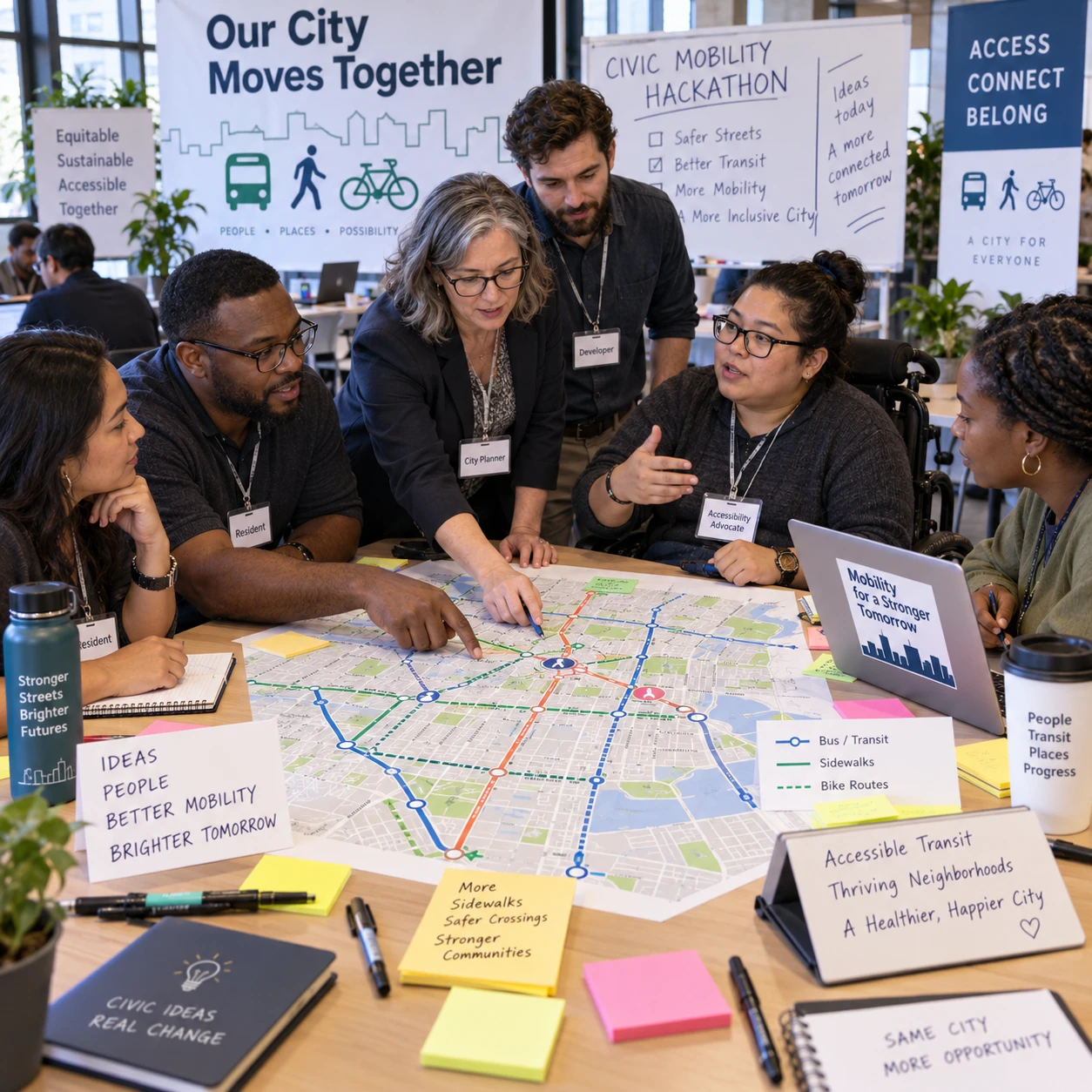
How Civic Tech Hackathons Drive Government Innovation

A city department may know that residents struggle to find a service, report a hazard, or understand a public dataset. The harder question is what to change, and how to test a better approach. A civic tech hackathon can bring the people closest to that problem into the same room as those who can explore possible solutions.
These events can spark government innovation, but a prototype alone does not improve a public service. Results depend on a clearly defined need, responsible use of data, community involvement, and a credible plan for what happens after the event.
What Is a Civic Tech Hackathon?
A civic tech hackathon is a time-limited collaboration where government, technologists, residents, and other partners develop and test ideas for public problems. Unlike a conventional coding event, it starts with a civic need and treats technology as one possible response, not the goal.
Teams may use open data, service maps, policy knowledge, or resident experience to build a digital mock-up, data analysis, or early service workflow. The output might be an interactive prototype, a clearer way to explain eligibility, or a proposal for improving how a department handles requests. It is usually a learning tool, not a finished product.
That distinction matters. Public services must meet accessibility, privacy, security, language, and operational requirements. A weekend prototype has not necessarily been tested against those standards or connected to government systems. The value of a civic tech hackathon lies in helping people examine a problem together and make an idea concrete enough to assess.
Why Governments Use Hackathons to Address Public Problems
Governments use civic tech hackathons to explore public-sector challenges with people who bring different knowledge and perspectives. Focused collaboration can reveal overlooked needs, generate alternative approaches, and help teams test assumptions before committing to a larger project.
Public problems often cross organizational boundaries. A resident seeking housing support, for example, may encounter several departments and community organizations. A hackathon can map that journey and expose where information, referrals, or handoffs break down. The useful innovation may be a better process, not a new app.
Open data can also help teams investigate questions that are difficult to see from inside one department. Transit, service-request, or budget datasets may suggest patterns worth exploring. But data needs context: it may be incomplete, out of date, or collected in ways that leave some communities underrepresented. Participants should ask what the data can support and what it cannot prove.
Hackathons can also build trust when residents have a meaningful role in defining the problem and judging ideas. A public event that asks communities for input only after officials have chosen the solution is unlikely to produce that benefit. In other words, the event format creates an opportunity for cross-sector collaboration; organizers still have to make the collaboration real.
Who Participates—and What Each Group Brings
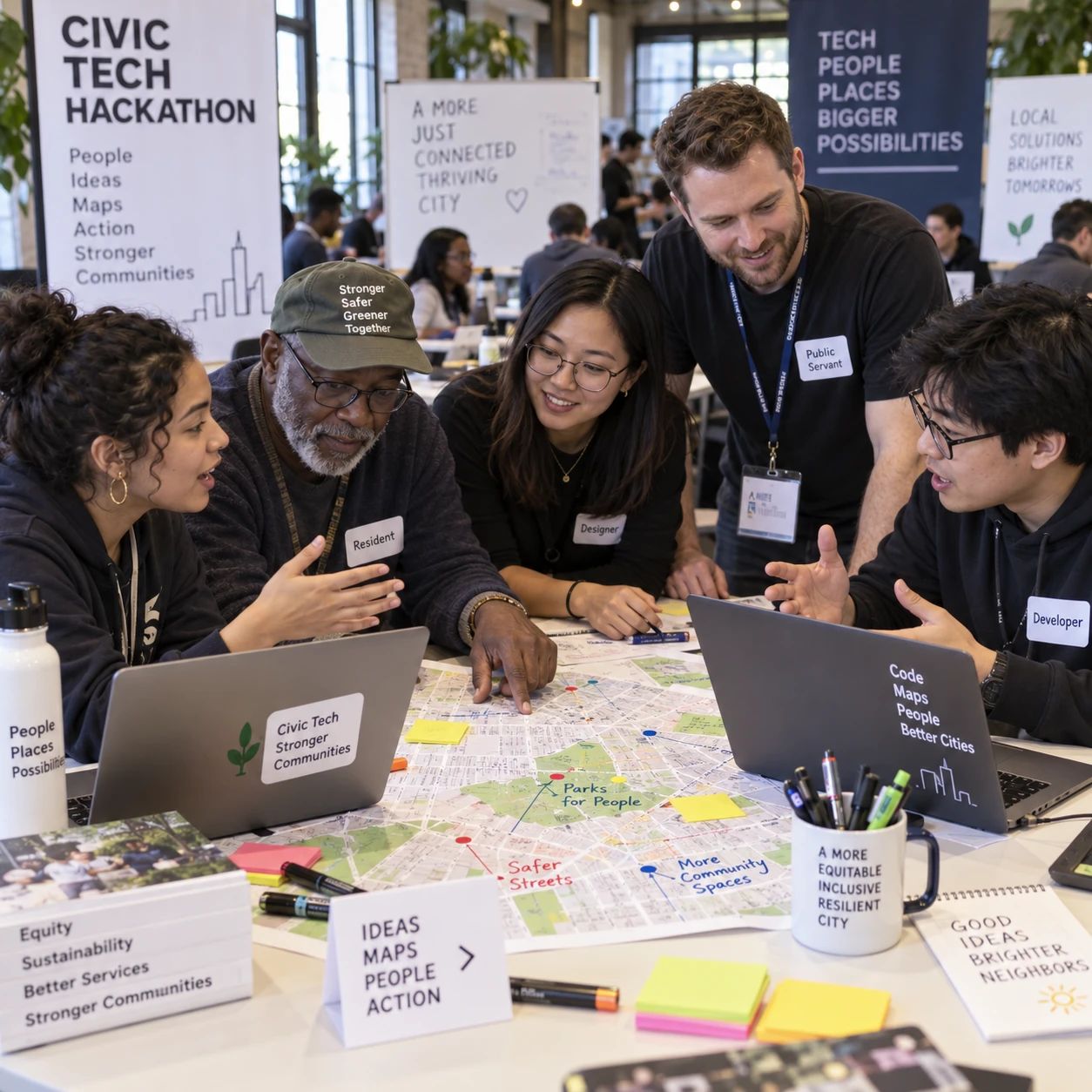
Effective civic tech hackathons include people who understand the public need, those affected by it, and people who can explore ways to address it. A mix of participants helps teams avoid designing for a narrow or imagined user.
- Public servants explain service rules, operational realities, legal constraints, and decision-making authority. They can clarify what a department can change and who would own a proposal.
- Residents and service users describe real experiences, barriers, and priorities. Their participation should influence problem selection and evaluation, not serve as a one-time testimonial.
- Technologists and data specialists assess technical options, work with open data where appropriate, and develop prototypes or analyses.
- Designers and accessibility specialists help make services understandable and usable across different abilities, languages, and levels of digital access.
- Community organizations contribute local relationships and knowledge, including insight into groups that may not be reached through an online sign-up form.
Organizers should remove practical barriers to participation. Offer nontechnical roles, plain-language materials, accessible venues, interpretation where possible, and compensation for community expertise when resources allow. Otherwise, the event may mostly hear from people who already have time, devices, and confidence navigating government.
From Challenge Setting to Working Prototype
To move from a public concern to a useful prototype, organizers should define a specific challenge, prepare relevant information, form balanced teams, and test ideas with people affected by the problem. Clear boundaries help participants focus without dictating the answer.
1. Choose a meaningful, workable problem
Start with a service or policy question that has an identifiable public impact and a government partner willing to engage. “Improve public safety” is too broad. “Help residents find the correct process for reporting a broken streetlight” is more concrete, though teams should still investigate why residents struggle and what the reporting system can actually change.
2. Prepare data and constraints
Share useful open data, service information, and user research in a form participants can understand. Explain known gaps and restrictions. Do not expose personal or sensitive records simply to make a challenge seem more technical. If the problem needs confidential data, use a safe, approved alternative or choose a different exercise.
3. Build teams around the problem
Mix policy, community, design, and technical perspectives. Give each team access to a department contact and a clear way to ask questions. Encourage teams to speak with intended users before building; a short conversation can overturn an assumption that would otherwise shape the entire prototype.
4. Test and present the idea
Teams should show what they learned, whom the idea serves, what it would require, and what remains uncertain. A clickable mock-up or service blueprint can be more useful than a rushed working app if it makes the user journey and operational dependencies visible.

Turning Hackathon Ideas into Real Government Solutions
Hackathon ideas become practical government solutions only when a department evaluates them, assigns ownership, and provides a realistic route to development and ongoing support. A prototype is evidence of an idea that can be discussed; it is not proof that the idea is safe, effective, or ready to launch.
Before the event ends, identify who will review proposals and when participants will hear back. Afterward, the responsible team can assess:
- Public value: Does the idea address a documented need, and who benefits?
- Feasibility: Can the department operate it with its systems, staff, and legal duties?
- Safety and access: Are privacy, cybersecurity, accessibility, language, and digital inclusion addressed?
- Resources and ownership: Is there a product owner, budget, maintenance plan, and decision-maker?
If an idea advances, it may need user research, security review, procurement, integration work, and a pilot before becoming a digital public service. Procurement rules and funding cycles can slow progress, while a volunteer-built prototype may be difficult to maintain. Those constraints are reasons to plan for implementation early, not reasons to promise a launch the event cannot guarantee.
A practical follow-through plan names the next decision, its owner, and a date. Even when a prototype does not proceed, documenting why it was declined can preserve learning and build trust with participants.
Benefits, Risks, and Ways to Measure Success
Civic tech hackathons can improve problem understanding, strengthen community engagement, and produce ideas worth testing, but they can also exclude people or create prototypes that never fit public operations. Measure progress beyond the number of projects presented.
Common risks include treating attendance as community representation, using incomplete data as if it were neutral, and rewarding polished software over a well-supported service improvement. Organizers can reduce these risks by recruiting through trusted community groups, making data limitations explicit, and judging teams on public value, feasibility, accessibility, and evidence from users.
Measure results at several stages:
- Participation: Who took part, whose perspectives were missing, and did residents shape the challenge?
- Learning: Did teams uncover service barriers, data gaps, or assumptions that departments can act on?
- Progress: Did any idea receive a named owner, further testing, or a funded discovery phase?
- Public impact: If a solution is implemented, does it improve a relevant measure, such as successful service completion, processing time, or user understanding?
Choose outcome measures before a pilot begins and compare them with a clear baseline where possible. A hackathon may have value even if no prototype launches, especially when it reveals that a process change or better information is needed instead. The honest test is whether the event leads to useful learning or responsible action, not whether it produces the most apps.
Frequently Asked Questions
What problems are suitable for a civic tech hackathon?
Suitable problems are specific, important to the public, and open to exploration within the event’s scope. Examples include making public information easier to navigate, improving a service-request journey, or identifying patterns in non-sensitive open data. Problems requiring complex legal decisions, confidential records, or major infrastructure changes usually need longer work than a hackathon can provide.
How can residents participate?
Residents can help choose challenges, describe their experiences, test prototypes, review ideas, or join organizing and judging teams. Organizers should offer accessible ways to contribute that do not require coding, explain how input will be used, and consider compensation for substantial community expertise.
Do hackathon prototypes usually become government services?
There is no reliable outcome that applies to every event. Many prototypes need more research, funding, technical work, and public-sector review before implementation; some are not suitable to advance. Organizers should describe a prototype as an early concept unless it has passed the necessary testing and approvals.
How can organizers evaluate a hackathon’s impact?
Track participation and learning as well as follow-through: whether ideas receive owners, move into testing, or lead to a change in service. If a solution is piloted, set a baseline and measure relevant outcomes, such as user success or processing time. Report what did not advance and why, so participants can see what the event achieved and what remains unresolved.